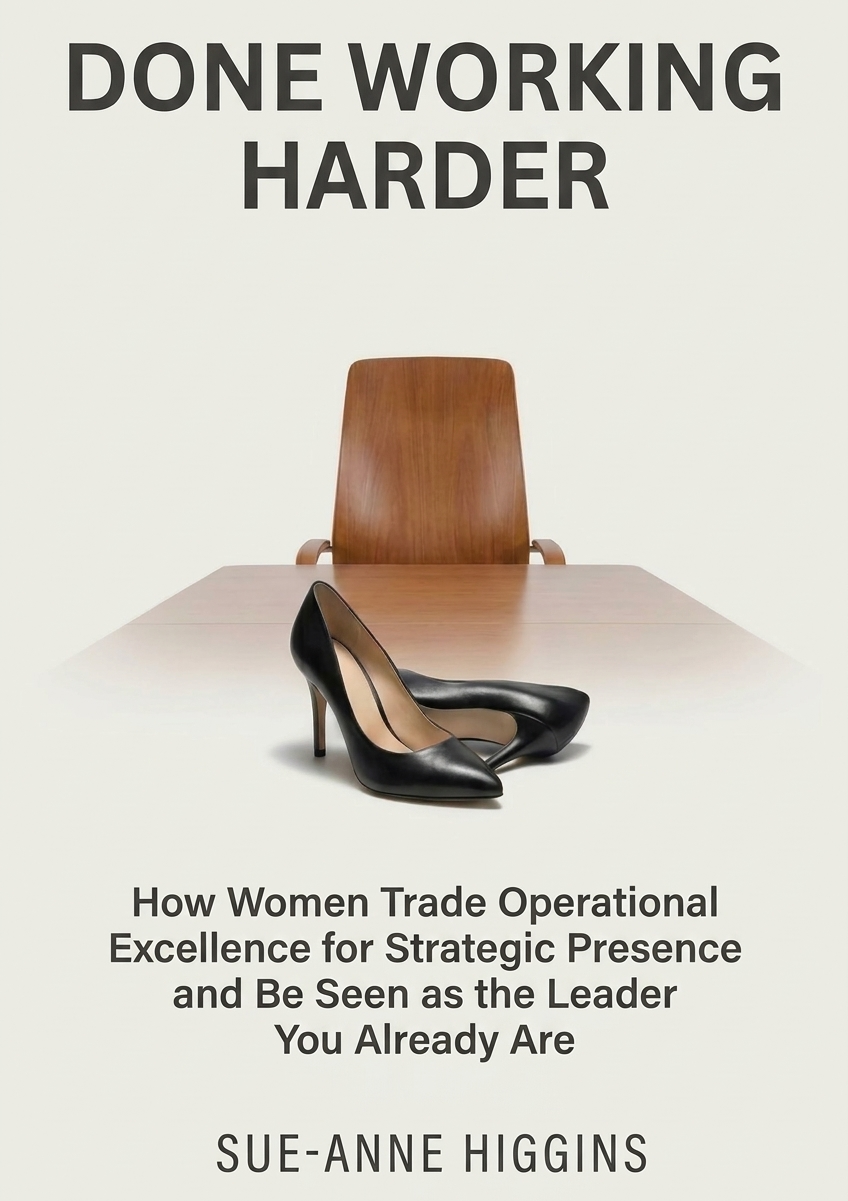
Done Working Harder
— A new book by Sue-Anne Higgins —

The Real Reason
Capable Women Get Overlooked
And It Isn't Capability

For the mid-to-late career woman leader who delivers everything, gets told "be more strategic" with no instructions, and watches the panel keep her exactly where she is already useful. This book reveals the reason why, and the exact method to more beyond it.

Yes! Rush me a copy — $20
Ebook only · Instant download

Someone Has Already Decided What You're Good At

It's 9:48pm. The house is quiet, yours is the only screen still on, and there's an email in your inbox that belongs to someone on your team. You know whose it is. You could forward it with one line. Instead you start typing, because you know the answer and explaining it to her tomorrow takes longer than doing it now.

Then there's the meeting. You made a clear contribution. You'd done the reading, spoken to the right people, connected two things nobody else in the room had connected. You said it, and the room did nothing. Two seconds of quiet. Maybe three. In that gap you heard a verdict, so you filled it. An example. A caveat. "What I mean is." By the time you stopped talking there was nothing left to accept.

"I know I'm capable of more than this." You've said it to a friend, or to the ceiling at 2am, and you meant it, and you still can't point at what's in the way.

If that's your week, you're not underperforming and you're not broken. Nobody is questioning your delivery, because there's nothing to question.

The problem isn't your skills, your confidence or your market. It's structural. Every time you demonstrate exceptional operational capability, you strengthen the case for keeping you exactly where you are already valuable. The work you use to prove you're ready for the strategic table is the very work keeping you from it.

The Shocking Truth About Why You're Still Stuck

You believe that if you keep delivering at this standard, someone senior will eventually notice and move you up. It's a reasonable belief. It's how you got every role you've ever had.

Here's the trouble. A promotion panel doesn't score effort. It scores evidence, and it reads the evidence in the pattern of what you have visibly done. Seven years of flawless delivery. Seven years of the crisis landing on your desk and getting resolved. Seven years of a team that never dropped anything, because you caught it.

What does that tell them? She gets it done. They're not wrong about you. They saw exactly what you showed them, every single day, and drew the obvious conclusion: she is enormously valuable where she is, and moving her would be a risk.

Nobody on that panel has ever seen you think. You never left the space to be seen thinking.

Why Traditional Approaches Keep You Trapped

The corporate program. The workbook you filled in properly, because you fill things in properly. The competency framework. The mentor who said back yourself. The 360 that said exceptional at delivery, could be more strategic. The drive home genuinely inspired, followed by a Monday that ate the intention before lunch.

Six serious attempts. And the conclusion your brain drew was quiet and reasonable and wrong: the common factor here is me.

It was never you. It was where the learning happened. A leadership program happens on the balcony, out of the day, with a model and a reflection sheet. The pattern fires at 2:14pm on a Wednesday, on the dance floor, in the half-second after your recommendation meets quiet and before your mouth opens again. One Tuesday in a training room does not outvote a decade of Wednesdays.

Add to that who gets the good development. Roughly ten percent. The executives, the identified high-potentials. The other ninety percent are expected to work out the next level on their own.

See, I Was Just Like You…

I spent most of my career inside organisations, in learning and development, then organisational development and complex change. Part of that job was designing the leadership development the organisation cared most about, and I noticed early who got it. I came to call them the golden inner circle, and I built a lot of very good programs for them.

Then I was running a workshop, and a woman in the room stopped.

She had been overlooked for promotion for seven years. Seven. She was talented, and I don't use that word loosely. Her confidence had gone somewhere she couldn't reach, and she'd arrived convinced she was the only person this had ever happened to. Partway through, whatever she'd been holding gave way.

I know what she'd been doing for those seven years. Trying harder. Taking on more. Carrying the decisions her team should have made. Polishing the recommendation for one more week. Every review, nearly there. Every year, more proof.

I stood at the front of that room and saw the thing I'd missed while I was busy serving the inner circle.

The proof was the problem.

The Balcony Revolution

The balcony isn't earned. It's stepped onto.

Picture the dance floor. You're on it, and you're very good. You know every step, you catch every dropped beat, you haven't missed a cue in years. Up on the balcony are the people deciding where the room goes next. They can see the whole floor from there, and what they see when they look for you is the best dancer in the building.

Nobody thinks to ask whether the best dancer would rather be upstairs.

The Strategic Leader Within Method™

The Method is a matched set. On one side, the 20 Try Harder Traps: the automatic responses that fire when a leadership moment gets uncomfortable, in three broad shapes. Do more. Explain more. Think more. On the other side, 102 Power Moves, each built to meet a specific trap inside a moment already in your diary. It works because it doesn't touch your skill set. Your skill set was never the problem. It changes the default reading your brain makes in the half-second before you reach for more, and the behaviour follows from there. You won't need 102 of them. You need the right one at the right moment. The book is where you find yours.

01
Reclaim Your Strategic Edge
Block Tiger Time so your two sharpest hours go to the work that needs your best brain, before the inbox arrives.
02
Lead, Don't Rescue
Problems go back to the people they belong to, and your hours come back with them.
03
Command the Room
Recommendation first, one reason second, and nothing third. Say it, stop, let them think.
04
Build Strategic Authority
The people who decide come to know how you reason, not only what you deliver.
05
Lead with Poise Under Pressure
The balcony view holds on the Monday of week three, when the old pattern offers itself with all the fluency of long practice.
06
Architect Your Living Legacy
The team, systems and culture stay stronger because you led, and you build that while you're still in the role.

The first three are things you do. The last three are things that become true about you.

Yes! Rush me a copy — $20
Instant download

What Others Are Saying

"I now take time to consider, process, acknowledge and address my thoughts. I now have direction and believe my goals are achievable. I am happier and so are the people around me."

SL | Finance manager

"Power move: Make yourself unavailable allowed me to move away from doing everything, allowed my team to pick up what they were supposed to be doing... I now have the space to think more strategically." 

JH | Senior Leader

Proven Results

Mia, an experienced L&D professional, was encouraged to apply for a Change Lead role. She read the job description and hit the line "deep expertise in change management practices", and that was the end of the reading. When I asked how confident she felt about the interview, on a scale of one to ten, she said three without having to think.

I asked her one question. What if it said deep expertise in human behaviour?

Her face changed before she spoke. "Oh! Eight. Definitely an eight."

Nothing about her capability had changed. Nothing about the role had changed. She had spent her entire career in human behaviour. One phrase had been standing between her and her own record, and she walked into that interview from a completely different position.

Jay was the reachable one. The whole floor routed its problems through her, because availability was how she'd always proved her value. She created deliberate windows when she could not be reached and held them. Decisions that had sat in a queue marked "waiting for Jay" started being made by the people who'd been waiting. She didn't become less supportive. She became more strategic about when her support was actually required.

What You'll Discover Inside

01
The Visibility Paradox
Why every heroic recovery adds another line to the wrong column of your reputation, and how the room reads that ledger when you're not in it.
02
The two Tuesdays
Same role, same team, same hours, nine weeks apart. Three moments changed. One sentence about her changed with them.
03
Which tendency is driving your week
A fortnight-long checklist for the Responsible Executor, the Thoughtful Contributor and the Careful Analyst, and why they're situations rather than personality types.
04
The four hurdles
They never appear in a performance review as weaknesses. Three of them appear as strengths. The fourth gets thanked.
05
The standard you inherited
A client, an A-minus and six words from a father that ran as an operating instruction for thirty years. What happened when I gave her permission to get a B.
06
What if the silence means they're thinking?
The ninety seconds in which a three-week recommendation gets dismantled by the only person in the room who could dismantle it.
07
Tiger Time, and why the version most people run fails
Where your peak hours actually sit, and the week of Time-In that finds them before you rearrange a single meeting.
08
The Strategic Command Centre and the Goldilocks Effect
Why sixty small decisions before 10:30am leave you writing the most important paper of your quarter on an overdrawn account.
09
The sentence that hands a problem back
And the four seconds after it that decide whether the hand-back was real.
10
When Dave says your idea ten minutes later
One flat sentence that claims authorship without a fight.
11
The four ways the change quietly comes undone in week two
Including the one that looks exactly like kindness.
12
The Strategic Triangle and the Navigator
Three questions to slow a moment down, and the third one that does all the work: what am I protecting?

Is This Right For You?

This is NOT for those who —
  • Want a new system, a colour-coded planner or a 6am start. Nothing gets added to your week, and the 6am start is worse than useless.
  • Want to be taught office politics. Handing an email back to the person it belongs to is management, not manoeuvring.
  • Would rather collect all 102 Power Moves than use one. That's the Careful Analyst gathering certainty while the trap runs unopposed.
  • Think another model of strategic leadership is what's missing. Ask yourself to describe a strategic leader and you'll produce a paragraph. Knowing was never the gap.
This is for —
  • The woman who is good at her work and tired of that being the only thing anyone can see.
  • You don't have to want the CEO's job.
  • You don't have to be loud or more like a man.
  • You have to be willing to do one thing differently in a moment already sitting in your diary.
Yes! Rush me a copy — $20
Instant download

Frequently Asked Questions

Is this just another leadership book?
No. Every chapter is built around a moment already in your week: the recommendation you're carrying into Thursday, the problem that lands Wednesday, the two hours tomorrow morning the inbox is about to take. It's short on purpose. Read it in one sitting, two at most.
Do I need more time to do this?
You don't have an hour to spare and I won't pretend otherwise. Every Power Move replaces something you were going to do anyway, in the same thirty seconds, and most of them involve doing less than you currently do.
Will this make me push, posture or play politics?
No. A woman who talks for four minutes is louder than one who says twelve words and lets them sit. Nothing here asks you to become someone else.
My organisation is different.
It may well be. The pattern travels anyway. The 9:48pm email lands everywhere. The room goes quiet everywhere. What differs is how loudly the culture rewards the rescue, and it rewards it everywhere.
How fast will I see something?
The first fortnight is nearly always good. It's the Monday of week three, when you slept badly and the old sentence is right there in your hand, that tells you whether the change is holding. The book prepares you for that Monday specifically.
What if I only remember one thing?
Good. Say it. Stop. Let them think. That's the move, and it works in the meeting, in the inbox and in the two hours before anyone else is geared up to want them.
Sue-Anne Higgins

Sue-Anne Higgins.

Sue-Anne Higgins is a strategic leadership coach and the creator of the Strategic Leader Within Method™. She spent more than twenty-five years inside organisations, in learning and development, organisational development and complex change, designing the leadership development that went to the golden inner circle, before turning that experience toward the women it had been passing over.

Since then: hundreds of women coached through the leadership moments that never fit a competency framework, more than 600 coaching hours, 50+ one-to-one clients, 226 group coaching clients. Every trap and every move in the Method came out of their weeks, not out of a textbook.

Her mission carries a number: to positively impact one million people, by transforming communities from the inside out, one woman at a time. She doesn't plan to coach a million women. She doesn't have to. One leader who stops rescuing, protects her best hours and lets her recommendation land changes the working life of everyone around her, and then the home lives of those people, and then the way their teams get led.

Find the Next Two Working Days in Your Diary

Somewhere in those forty-eight hours there is a morning you haven't yet handed to the inbox, a problem that will arrive belonging to someone on your team, and a meeting where you'll have a recommendation to make. Nothing needs adding. The moments are already booked.

Picture the version of you who walks out of that meeting having said twelve words and stopped. Whose team member solves the supplier problem without her. Whose laptop shuts at six and stays shut. Same job. Same hours. A different sentence said about her in rooms she isn't in.

From dance floor to balcony

They've watched you
get it done for years.
Let them watch you think.

Same job, same hours, a different sentence said about you in rooms you aren't in.

Yes! Rush me a copy — $20
30-day refund · Ebook only · Instant download